This is a free and open to the public hybrid event, held both inperson and online. Due to the newly effective insurance requirements, we regret that we can not allow people under 18 on the Chapman Campus, they are welcome to attend online.
This meeting’s speaker will present inperson on the campus of Chapman University.
THE SHAKING COSMOS:
Observing the Universe in
Gravitational Waves with LISA
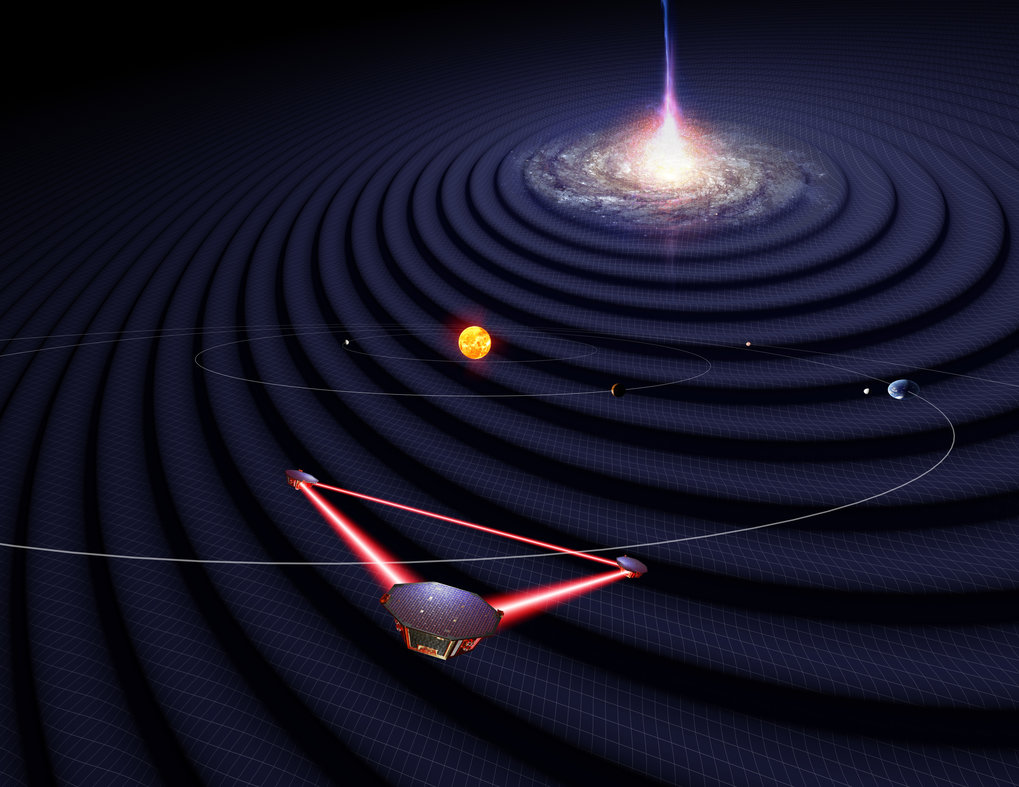
Virtually everything we know about the Universe has been discovered from the study of photons — light in all its myriad forms from radio waves, to visible light, to x-rays and beyond. At the dawn of the 21st century, advanced technology is providing access to the Cosmos through detection of sub-atomic particles like cosmic rays and neutrinos, and through detection of ripples in the fabric of spacetime itself.
These ripples in spacetime, called gravitational waves, carry information not in the form of light or particles, but in the form of gravity itself. Gravitational waves are messengers which carry the stories of what happens when two black holes collide at the centers of galaxies, of how the compact stars fall into monstrous black holes, and of how the graveyard of the galaxy is filled with the quiet whisper of binary white dwarf stars that spiral together ever so slowly as they fade into oblivion.
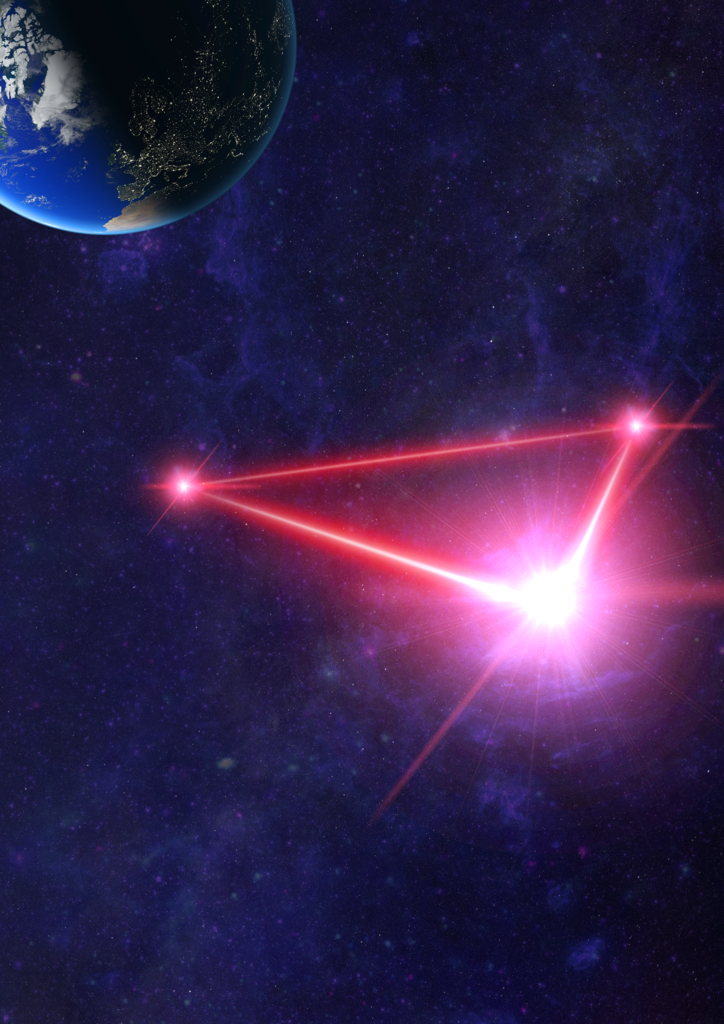
This talk will explore the modern description of gravity, what gravitational waves are and how we hope to measure them, and what we hope to learn from their detection. We’ll focus on the forthcoming space gravitational wave observatory, LISA, being launched in the early 2030s by ESA and NASA. Gravity has a story to tell, and in this talk, we’ll explore some of discoveries we hope to make by listening.
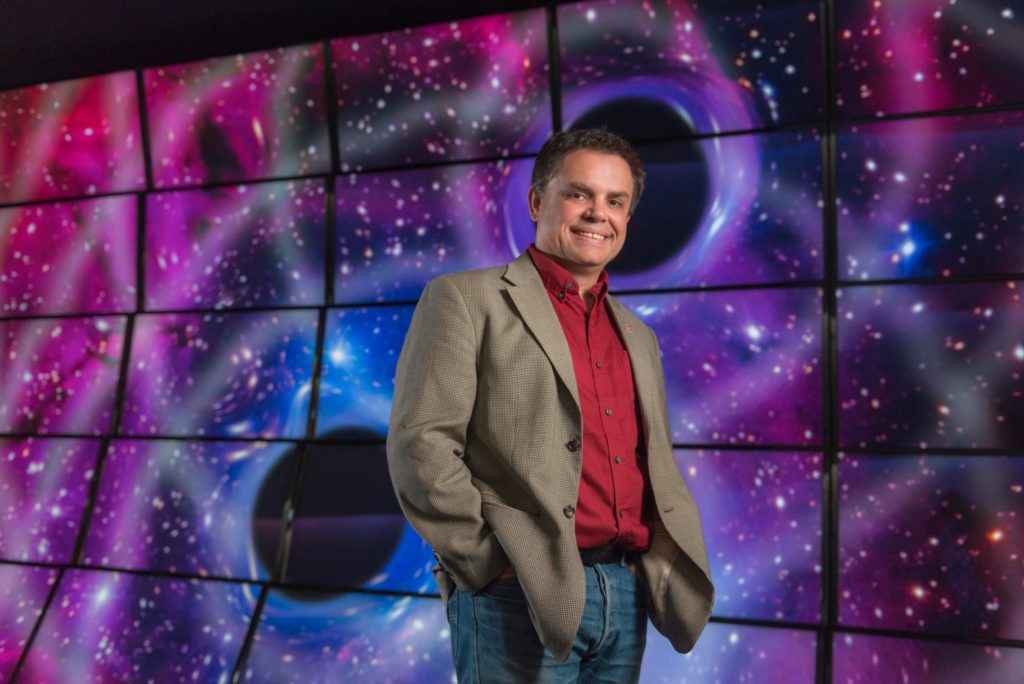
Shane Larson is a research professor of physics at Northwestern University, where he is the Associate Director of CIERA (Center for Interdisciplinary Exploration and Research in Astrophysics). He works in the field of gravitational wave astrophysics, specializing in studies of compact stars, binaries, and the galaxy. He works in gravitational wave astronomy with both the ground-based LIGO project, and future space-based observatory LISA. He was formerly a tenured associate professor of physics at Utah State University. He is an award winning teacher, and a Fellow of the American Physical Society. He contributes regularly to a public science blog at writescience.wordpress.com, and tweets with the handle @sciencejedi
Views: 1
This is a free and open to the public event (in person event only)
The 6th session of the Beginners Astronomy Class covers the basics of astrophotography, covering different types of imaging, how different types of cameras are used for this kind of photography, and other equipment and considerations for taking a good picture.
This session is taught by Kyle Coker, who is active in the club’s AstroImaging special interest group.
Free and open to the public as well as members of OCA.
For details, please visit here and download the sample information PDF package.
Views: 3
This is a free and open to the public event (In-person event only).
The 5th session of the Beginners Astronomy Class is the “How to Use Your Telescope”.
If you have a telescope and would like some help learning to set it up and use it, attend this Hands-on class.
For details, please visit here and download the sample information PDF package.
Views: 2
This is a free and open to the public online event, to attend please register with zoom by clicking here at or after 7:10pm.
The 4th session of the Beginners Astronomy Class covers the science behind the telescope.
How do our eyes actually perceive objects we see in the telescope and what is the physics that allows that perception.
For details, please visit here and download the sample information PDF package.
Views: 0
This is a free and open to the public online event, to attend please register with zoom by clicking here at or after 7:10pm.
The 3rd session of the Beginners Astronomy Class covers different methods of finding objects in the night sky. Special topic is learning the constellations.
For details, please visit here and download the sample information PDF package.
Views: 1
This is a free and open to the public online event, to attend please register with zoom by clicking here at or after 7:10pm.
The 2nd session of the Beginners Astronomy Class covers the different types of equipment used to observe the night sky, including telescopes, mounts, eyepieces, filters, and advantages and disadvantages of different options.
This session is a must if thinking about buying a telescope.
For details, please visit here and download the sample information PDF package.
Views: 2
The current forecast is for 102F today and is currently 99 on site, there is a large fire that is uncontrolled in the Moreno Valley, north of Hemet at Gillman Springs Road that is currently 4400+ acres and growing. Smoke from that fire was heavy enough last night to affect seeing and cause eye irritation from a report I got from some people onsite. There is also a forecast for high thin clouds. The smoke will probably be very similar today and tonight. So due to the extreme heat and smoke and air quality it is recommended do not go to the Anza site. While the site is still open to members the StarBBQue has been cancelled.
Views: 0
This is a free and open to the public hybrid event, held both inperson and online. Due to the newly effective insurance requirements, we regret that we can not allow people under 18 on the Chapman Campus, they are welcome to attend online.
This meeting’s speaker will present online from Heidelberg, Germany.
A Journey Through Binary Black Holes
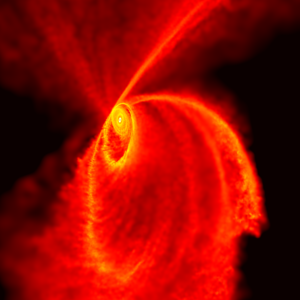
The zoo of binary black holes has never been so rich. Before the first LIGO-Virgo detection of gravitational waves in 2015, we could only speculate about the existence of binary black holes, i.e. systems composed of two black holes orbiting about each other. Now, the number of detected binary black holes approaches the 100 mark, and we expect many new discoveries in the next few months. The mass of the black holes observed by LIGO and Virgo ranges from a few up to a few hundred times the mass of our Sun. Some of them are relatively nearby, others merged several Billion years ago and their gravitational wave signal reached us from far away. In this talk, we will explore the main properties of binary black holes and discuss their main formation channels and open questions.
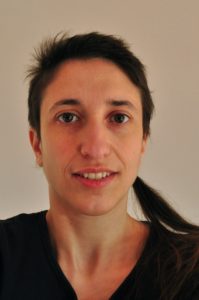
Michela Mapelli obtained her PhD in Astrophysics from the International School for Advanced Studies (SISSA/ISAS, Trieste, Italy) in 2006. She then moved to Zurich (Switzerland) for a postdoctoral fellowship. In 2010, she got a permanent research position at the Italian National Institute for Astrophysics (INAF), where she built her first research group focused on the study of black holes of different sizes. After holding a professorship at the University of Innsbruck (Austria, 2017-2018) and Padova (Italy, 2018-2023), she recently became Full Professor of Computational Physics at the University of Heidelberg (Germany). During her career, she obtained several prizes for her research on black holes, including the MERAC Prize 2015 for the Best Early Career Researcher in Theoretical Astrophysics and a Consolidator Grant of the European Research Council. In 2009, several years before the first gravitational-wave detection, she proposed the formation of black holes with mass about 30-50 times the mass of our Sun. She is now an enthusiastic member of the LIGO-Virgo-KAGRA collaboration and is planning for the next-generation gravitational-wave detectors.
Views: 5
This is a free and open to the public hybrid event, held both inperson and online. Due to the newly effective insurance requirements, we regret that we can not allow people under 18 on the Chapman Campus, they are welcome to attend online.
This meeting’s speaker will present inperson on the campus of Chapman University.
Tips and Secrets on Planetary Imaging
This talk will discuss the preparation, imaging capture and processing for Planetary Imaging.
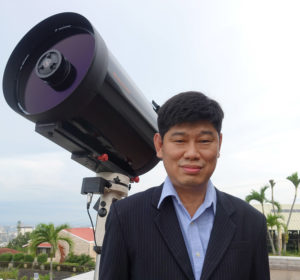
Christopher Go lives on the island of Cebu in the Philippines. He has been an amateur astronomer since 1986, the year of the return of Halley’s Comet. He studied at the University of San Carlos where he received a BS in physics.
Starting as an amateur astronomer with a pair of 10×40 binoculars, Chritopher Go would later own several different telescopes. He currently uses a Celestron C14 for planetary imaging.
Chris’s main astronomical interests are planetary imaging, particularly of Jupiter and Saturn.
In February 2006, Christopher Go discovered that the white spot Oval BA of Jupiter (later called Red Spot Jr.) had turned red. He joined planetary scientists Imke de Pater and Phil Marcus to observe Jupiter in the spring of 2006 with the Hubble Space Telescope. He was also involved with follow-up Hubble and Keck telescope observations of Jupiter.
In 2008, he received the Association of Lunar and Planetary Observers’ prestigious Walter Haas Award. In June 3, 2010, he confirmed the Jupiter Impact that was observed by Anthony Wesley. Asteroid 2000 EL157 has been named 30100Christophergo, in his honour.
Views: 3
OWENS VALLEY RADIO OBSERVATORY TRIP
SCIENCE BEYOND THE BOOK
June 23-25, 2023
With Dr. Mark Hodges and
Dr. Doug Millar and Cecilia Caballero, MA
Please join with us on the above date for an extraordinary adventure in science education at the Owens Valley Radio Observatory outside of Big Pine, CA. Included are science demonstrations at the 40m radio telescope and a tour, walking a scale model of the Solar System, solar astronomy, and night time astronomy. We will also make ice cream with liquid nitrogen.
This year we are emphasizing the DSA projects that are being built at OVRO. (See the OVRO website for more info: http://www.ovro.caltech.edu
If you want to come on Friday, we will have an evening of astronomy to the south of Building #10 at the west end of the observatory. You can bring your own telescope and there will be a number of telescopes set up to share their views. 120V AC is available. We will also do astronomy on Saturday night. The main program will be on Saturday afternoon, starting in the dining area in Building #10. We will go to the Pizza Factory in Bishop for dinner.
All the above is free and courtesy of Dr. Mark Hodges, OVRO, and Caltech. This trip is open to teachers, students with their families, members of local astronomy clubs, and radio hams. You must RSVP to go on the trip to Dr. Millar so that we know how many to expect (contact information below). Please also forward your cell phone number.
This is not a school or OCA sponsored event. Everyone is on their own for transportation and lodging. You have many options. You can stay at a motel nearby, camp in a campground, bring a tent or trailer and stay at the OVRO site. If you decide to camp at OVRO, you must provide your own bathroom, as the buildings will be locked. There are places to eat in Big Pine and Bishop.
Please arrive at OVRO by 1:00 PM on Saturday for the program.
The weather will be warm and dry. Evenings will be a little cooler, so dress accordingly for the nighttime astronomy.
Schedule:
Friday-
Setup telescopes to the south of building #10 for astronomy by sunset. 110v AC, bathroom and coffee and water available.
Saturday
1:00pm: arrive at kitchen in building #10 for start of program and tour.
5pm: check in at your Motel (if not already checked in) and go to dinner in Bishop.
Evening- Astronomy at the site
Sunday
A lot of us like to gather for breakfast about 9:30 at one of the local restaurants. More information will be available on Saturday.
Leave whenever you like. Check websites about the area and the Highway 395 for sightseeing opportunities.
The directions from the LA area are: Drive north on the 5/14 through Palmdale and Mojave. Continue past Inyokern and join 395. Continue on North through Little Lake, Lone Pine and Independence. Continue through Big Pine. Just as you get to the end of town turn right on Highway 168 towards the Westgard Pass. Go about 2 miles and turn left onto Leighton Lane, the observatory road. You should be able to see the 40m dish in the distance, but it is 4 miles away! Continue through the gate onto the property and follow the blacktop road. Go past two 90-foot telescopes to the west end of the site and park. Below is a more detailed map. The observatory address is: 100 Leighton Lane, Big Pine, CA.
If you would like to bring your own telescope, please do so. If you have a telescope and don’t know how to use it, please bring it as there will be people to show you how to properly set up and use the telescope.
For any questions and RSVP’s my contact information is
Dr. Doug Millar Cell- 562-810-3989 and email is drzarkof56@yahoo.com
Thank you and I hope to see you on the trip!
Dr. Millar
Local Directions to the observatory:
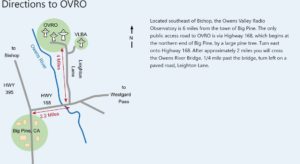
n.b. The large pine tree no longer exists.
Here are some pictures from past visits.
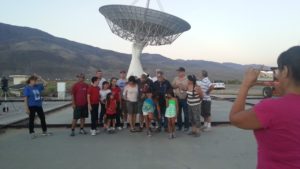
Students lined up in front of one of the two 90ft. dishes
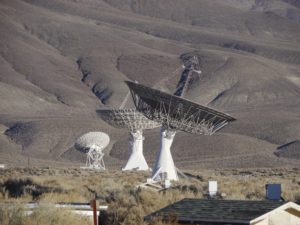
Our main dish to explore is the middle one at 40m in diameter.
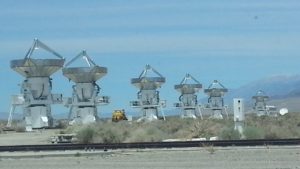
Ex CARMA Array dishes at the site.
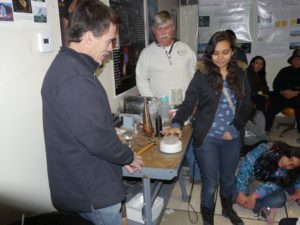
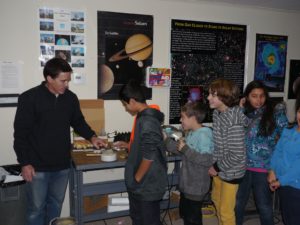
Experimenting with liquid nitrogen. Dr. Mark Hodges from OVRO and Dr. Millar
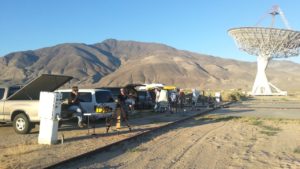
Astronomers setting up.
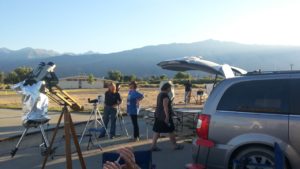
Getting set up for night time astronomy. Lots of great telescopes.
Views: 12
