This is a free and open to the public online event, to attend please register with zoom by clicking here.
The 2nd session of the Beginners Astronomy Class covers the different types of equipment used to observe the night sky, including telescopes, mounts, eyepieces, filters, and advantages and disadvantages of different options.
This session is a must if thinking about buying a telescope.
For details, please visit here and download the sample information PDF package.
Views: 2
This is a free and open to the public online event, to attend please register with zoom by clicking here.
The 3rd session of the Beginners Astronomy Class covers different methods of finding objects in the night sky. Special topic is learning the constellations.
For details, please visit here and download the sample information PDF package.
Views: 2
This is a free and open to the public online event, to attend please register with zoom by clicking here.
Psyche: Journey to a Metal World
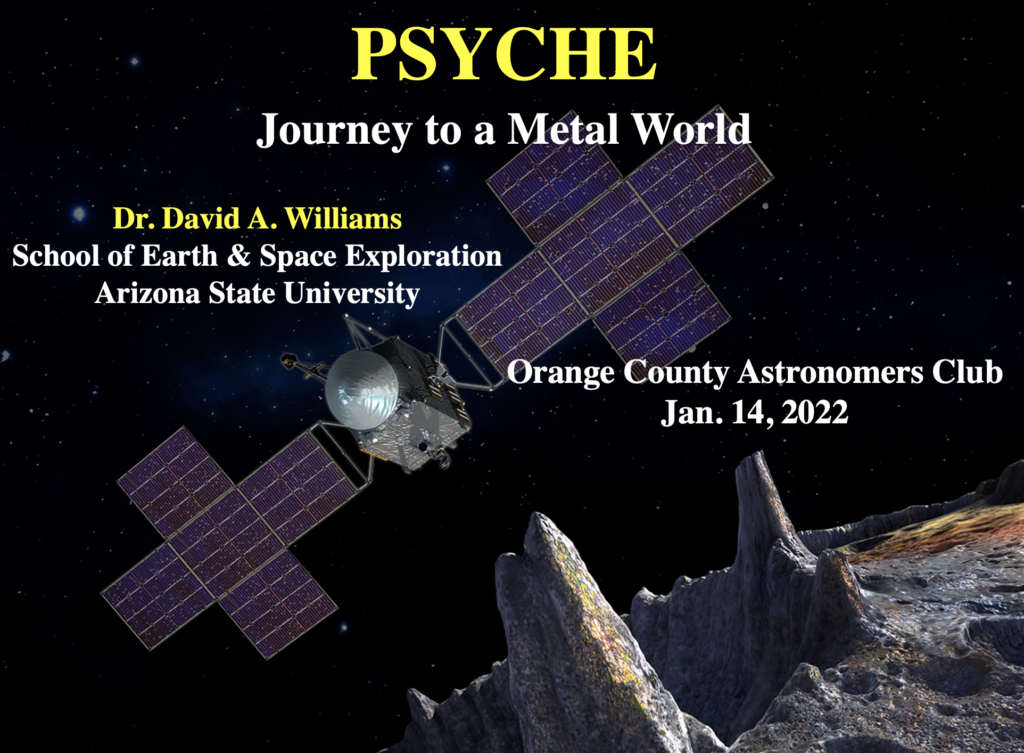
NASA selected Psyche as the 14th Discovery mission on Jan. 4, 2017. Led by Arizona State University, Psyche will be the first orbiter of a M-class asteroid, (16) Psyche. The mission design is based on NASA’s Dawn mission at Vesta & Ceres, and uses instruments with a strong heritage from past missions. Our science objectives are to answer the following questions: 1) Is Psyche an exposed planetary core, or did it never undergo melting? 2) What are the relative ages of features on its surface? 3) Do small metal-rich bodies incorporate light elements expected to be inside Earth’s high-pressure core? 4) Did Psyche form under more oxidizing or more reducing conditions than Earth’s core? and 5) What is the topography of this metal world? Psyche will launch in Aug. 2022 and will enter orbit of (16) Psyche in Jan. 2026 for a 21-month nominal mission. Psyche will study the surface using a pair of multispectral imagers (clear filter & 7 color filters, for surface morphology, stereo topography, and detection of certain key mineral classes), a gamma-ray & neutron spectrometer (for elemental abundances), and dual fluxgate magnetometers (to search for a remanent magnetic field). A gravity investigation using tracking of the spacecraft’s radio signal is also planned. Psyche will characterize surficial geologic features, topography, and compositions through four consecutively lower orbital phases, each optimized to obtain data to accomplish our science objectives. Psyche will: 1) map ≥80% of the surface with long-l filters at ≤500m/pix (assess metal to silicate fraction), 2) map ≥80% of the surface with short-l filters at ≤200m/pix (spectral detection of oldhamite, (Ca,Mg)S), 3) map ≥50% of the surface with clear filter at ≤200m/pix (crater counting), 4) map ≥80% of the surface with clear filter at ≤20m/pix (geologic mapping), and 5) determine the shape of (16) Psyche by mapping with clear filter over ≥80% of its surface with ≤200m/pix using stereo imaging techniques. This presentation discusses details of our mission.
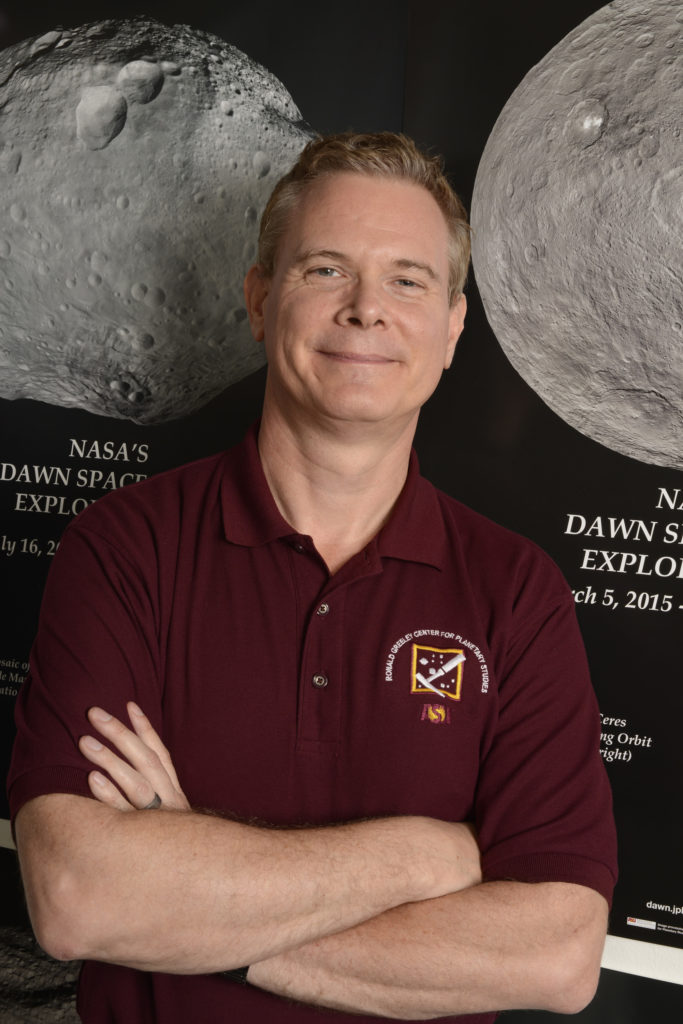
Dr. David A. Williams is a Research Professor in the School of Earth and Space Exploration at Arizona State University, Tempe, Arizona. Dr. Williams is the Director of the Ronald Greeley Center for Planetary Studies, a NASA-supported planetary data center at ASU. He is also the Director of the NASA Planetary Aeolian Laboratory, which administers wind tunnels the Ames Research Center in California. David is currently performing research in volcanology and planetary geology, with a focus on planetary mapping, geochemical, and remote sensing studies. His current research focusses on planetary geologic mapping of bodies across the Solar System, and computer modeling of the physical and geochemical evolution of lava flows in a variety of planetary environments. He was involved with NASA’s Magellan Mission to Venus, Galileo Mission to Jupiter, Dawn Mission to asteroid Vesta and dwarf planet Ceres, and ESA’s Mars Express orbiter mission. He is a member of the Janus camera team for the ESA JUICE mission, and he is currently Deputy Imager Lead and a Co-Investigator on NASA’s Psyche Mission, scheduled to launch in August 2022. In 2014 David was elected a Fellow of the Geological Society of America, and asteroid 10,461 DAWILLIAMS was named in his honor.
ASU Psyche Mission: https://psyche.asu.edu/
JPL Psyche Mission: https://www.jpl.nasa.gov/missions/psyche
Website: https://rgcps.asu.edu/dawilliams/
Facebook: https://www.facebook.com/profile.php?id=10023395
Twitter: @davidaw222
Instagram: @davidaw222
Views: 1
This is a free and open to the public online event, to attend please register with zoom by clicking here.
An Antarctic Odyssey: Winter-Over at South Pole Station
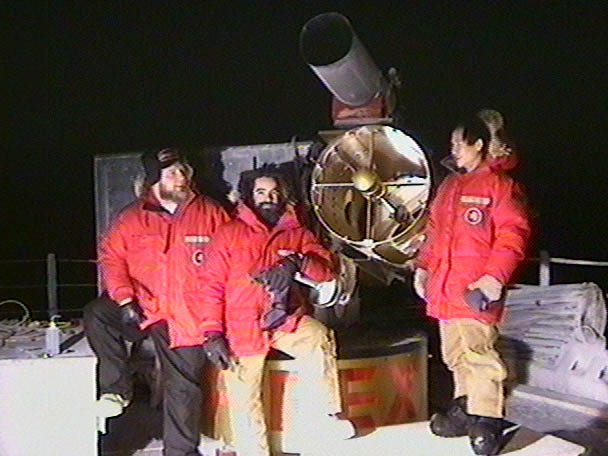
In a lavishly illustrated presentation, John W. Briggs of New Mexico will describe his year-long experience living at the Geographic South Pole while working for the Center for Astrophysical Research in Antarctica. In preparation for this at Yerkes Observatory of the University of Chicago, John was a team member building a 24-inch infrared telescope and related experiments that were set up at the Pole in time for him and colleagues to observe the July, 1994, explosive crash of fragmented comet Shoemaker-Levy 9 into the planet Jupiter.
John weathered the “winter-over” with 26 other members of the U.S. Antarctic Program in an experience that many believe approximates what life will be like someday at a lunar or Martian outpost. Once begun, South Pole winter-over is an irreversible commitment, since the Program’s special LC-130 ski planes can’t land in the winter temperatures — in 1994, sometimes as low as 107 degrees F. below zero (with windchill, as low as -180 degrees). John will delight the audience with his perspective on the total South Pole experience — the strange natural environment, the odd social atmosphere, and the challenging, ongoing science.
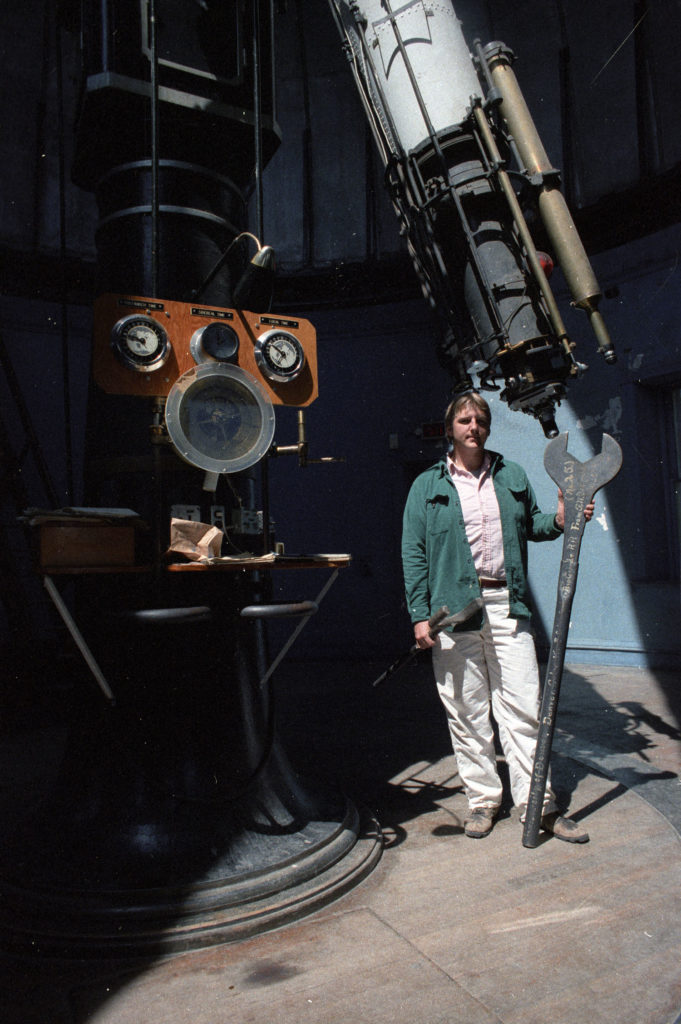
John W. Briggs has lived and worked at far-ranging observatories in various technical capacities, including Mount Wilson, Yerkes, National Solar, Maria Mitchell, Venezuelan National, Chamberlin, and South Pole Station. He came to New Mexico with his family in 1997 to assist in the final commissioning of the Sloan Digital Sky Survey at Apache Point. In the 1980s he was an assistant editor at Sky & Telescope magazine and built Bogsucker Observatory in Massachusetts. He is a member of many astronomical organizations including the Springfield Telescope Makers responsible for the annual Stellafane Convention in Vermont, and he has recently been elected to the board of the century-old American Association of Variable Star Observers. His principal activity now involves the Astronomical Lyceum, an informal museum, library, laboratory, and lecture hall devoted to historical astronomy and its preservation, located in a 1936 former school gymnasium-theater in Magdalena, New Mexico. In the middle 1980s he assisted the late Professor Edgar Everhart, Director of Chamberlin Observatory, in his well-known program of cometary astrometry. John has many old friends in the Denver Astronomical Society.
Views: 2
This is a free and open to the public online event, to attend please register with zoom by clicking here.
Come and socialize with your fellow astronomy enthusiasts face-to-face virtually!
Bring your latest astrophotography, mini-presentation, questions or none and your own refreshments.
Views: 2
This Charter school will have students marvel at the stars with the help of OCA guest astronomers.
Views: 3
This is a free and open to the public online event, to attend please register with zoom by clicking here.
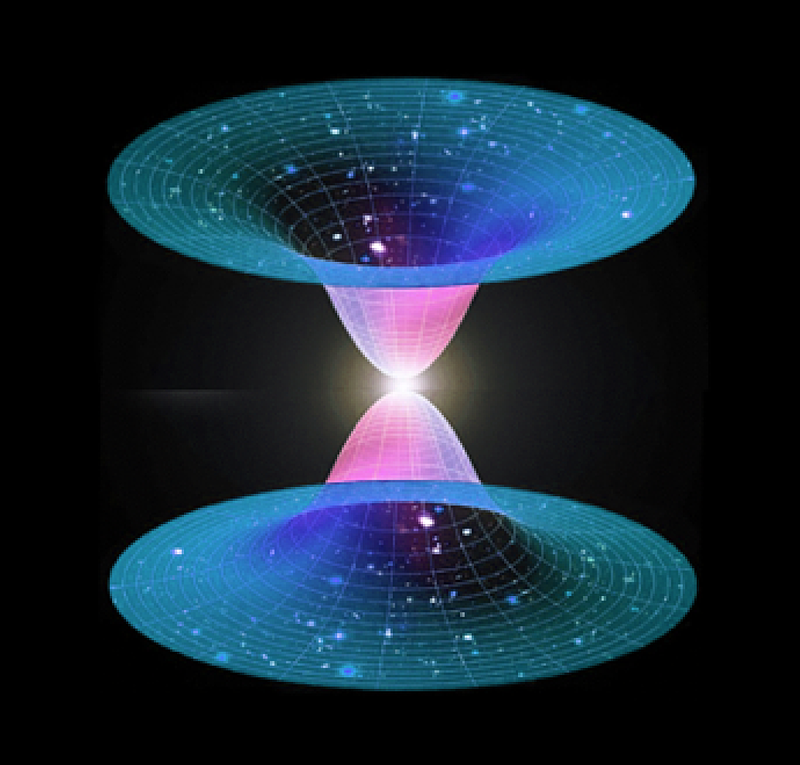
White Holes
Black holes are solutions of the Einstein equations long believed to be unphysical. Now we know they represent real things in the sky.
White holes are solutions of the Einstein equations long believed to be unphysical. Can they represent real things in the sky?
Carlo Rovelli is a theoretical physicist known for his work in quantum gravity. Born in Italy, he has worked in the United States, France and Canada. Rovelli is member of the Institute Universitaire de France, honorary professor of the Beijing Normal University, Honoris Causa Laureate of the Universidad de San Martin, Buenos Aires, member of the Académie Internationale de Philosophie des Sciences. In 1995 he has been awarded the Xanthopoulos Award for “the best relativist worldwide under forty”. He has written global best sellers among which are ‘Seven Brief Lesson on Physics’, translated in 44 language, ‘The Order of Time’ and the recent “Helgoland” on quantum theory. He has been included by the Foreign Policy magazine in the 2019 list of the 100 most influential global thinkers.
Views: 3
The Sirius Astronomy Newsletter is available each month here on our club website at
ocastronomers.org
Go to the Home page, and you will see a link to the Newsletter in the top menu list.
It is available before you would receive a mailed paper copy, and it is in color!
Electronic delivery also cuts down on printing and postage expenses for the club.
If you would like to stop receiving a paper copy of the Newsletter, please email Charlie with this request at
charlie@ocastronomers.org
Views: 2