What makes this long-running meteor shower unique is that it consists of two separate streams — the first created by grain dust left behind by Asteroid 2004/TG10, and the second by dust grains left behind by Comet 2P/Encke. It runs Sept. 7-Dec. 10. A nearly full moon at the peak will make viewing difficult.
Views: 1
Comet Haley is the parent of this meteor shower, which produces about 20 shooting stars an hour at its peak. The shower runs from Oct. 2-Nov. 7. The thin, crescent moon will leave mostly dark skies during the peak.
Views: 14
This is the one meteor shower of the year that is best viewed in the early evening hours. A minor meteor shower that runs Oct. 6-10, it produces about 10 shooting stars an hour. The first-quarter moon will blot out all but the brightest meteors from this shower, created by comet 21P Giacobini-Zinner.
Views: 3
Famous for producing a large number of fireballs, the Perseids meteor shower is regarded as one of the best of the year. The shower runs July 17-Aug. 24 and produces up to 60 shooting stars an hour at the peak. The shower, discovered in 1862, is produced by the comet 109/P Swift-Tuttle. A nearly full moon will cause viewing problems, but the Perseids are so bright that skywatchers should still get a good show.
Views: 5
This shower runs from July 12-Aug. 2 and produces about 20 meteors an hour at the peak. A new moon means dark skies, so viewing conditions should be excellent for this shower, which is produced by debris left behind by the comets Marsden and Kracht.
Views: 3
This above-average meteor shower runs from April 19-May 28. The best place to see it is in the Southern Hemisphere, where it produces about 60 meteors an hour, but it’s a decent show in the Northern Hemisphere, too, and viewers in this part of the world can expect to see about half that many
Views: 2
Lyrids meteor shower is an average shower, offering about 20 shooting stars an hour at the peak
Views: 2
This is a free and open to the public online event.
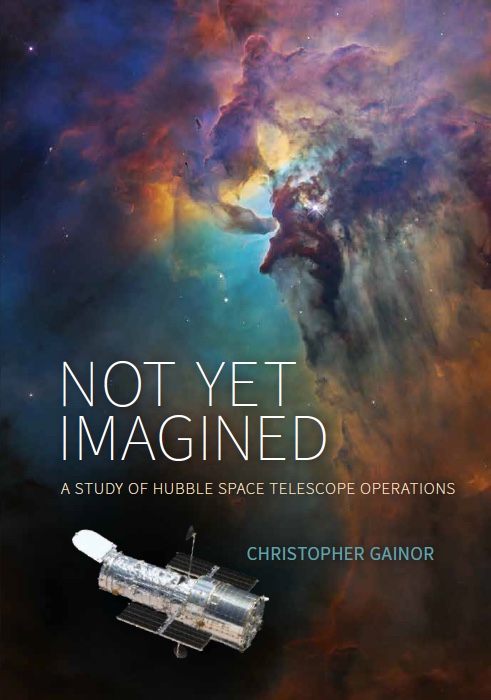
Three Decades of
the Hubble Space Telescope
After decades of discussion and construction, the Hubble Space Telescope was finally launched on April 24, 1990. While HST was not the first space telescope, it represented a major expansion in capability that has helped upend humanity’s understanding of the universe. HST helped show that the expansion of the universe is accelerating, and has transformed our view of the universe with a remarkable set of Hubble Deep Field images, amongst other things. Along the way, the engineers, scientists and astronauts behind HST managed to overcome a debilitating optical problem and have kept HST making discoveries for more than three decades. Now HST is about to work in tandem with its successor, the James Webb Telescope.

Christopher Gainor is a historian of technology specializing in space exploration and aeronautics. He has written four books on the history of space exploration and two on Cold War history. His most recent book is a history of Hubble Space Telescope operations published by NASA. Gainor is editor of Quest: The History of Spaceflight Quarterly. From 2018 to 2020, he was President of the Royal Astronomical Society of Canada, and he is a fellow of the British Interplanetary Society. Gainor holds a Ph.D. in the history of technology from the University of Alberta, and has worked as a history instructor at the University of Victoria and the Royal Military College of Canada.
Views: 3
This is a free and open to the public online event.
Oumuamua: The nearest exoplanet?
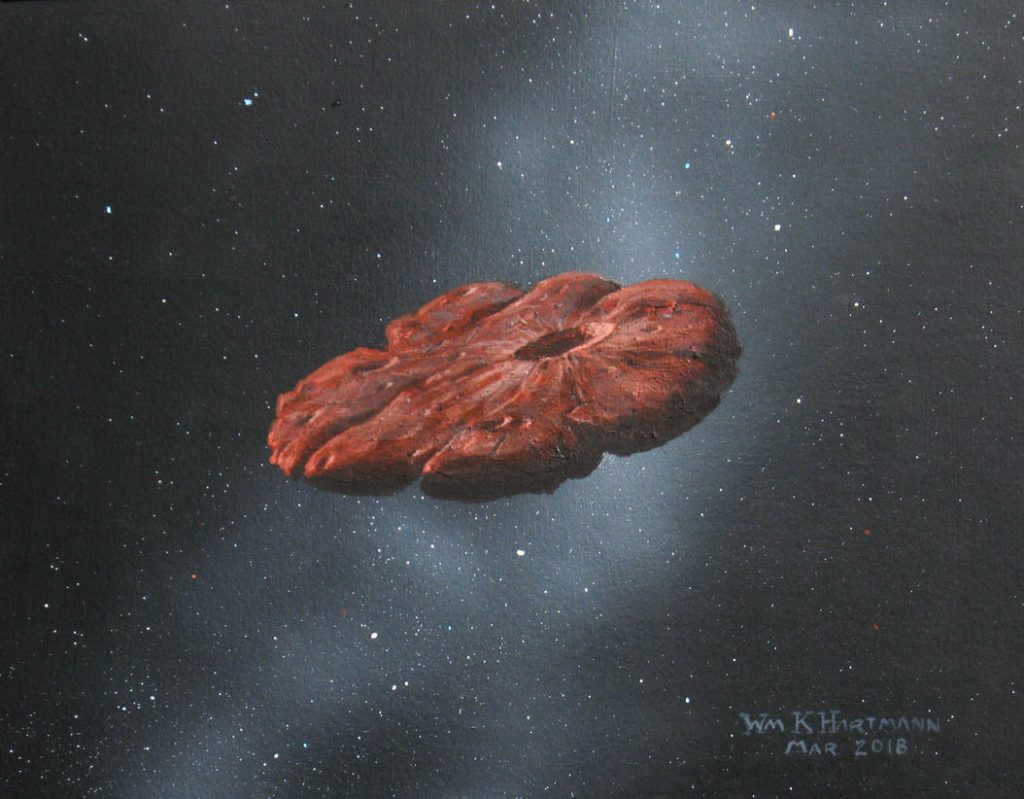
When ‘Oumuamua passed by Earth in October 2017, the only thing certain about it was that it was not from this Solar System. Because of its high velocity, it was the first confirmed interstellar object. The next year the object 2I/Borisov was the second confirmed interstellar object. But whereas Borisov behaved very much like a comet (albeit an unusual one), mysteries remain about what ‘Oumuamua actually is. Although it pushed away from the Sun by a rocket effect, like comets, it could not be made of water, or contain much carbon monoxide or dust, making it very unlike a comet. The acceleration it experienced was very large, and from the variations in sunlight it reflected, it was more elongated than any other solar system object: either a very skinny pancake or a very long cigar. Dozens of explanations have been proposed to explain these oddities, and speculation has run rampant, with some astronomers even suggesting it was alien technology. The truth is more mundane but no less exciting. In a pair of papers in 2021, Steve Desch and Alan Jackson demonstrated that ‘Oumuamua is consistent in every way with being a small fragment resembling the surface of Pluto. Our own solar system must have ejected trillions of fragments like ‘Oumuamua in its early days, and a population of fragments from the surfaces of Pluto-like exoplanets must be common throughout the Galaxy. ‘Oumuamua itself may have been ejected about 400 million years ago, from a Pluto-like exoplanet in a young system in the Perseus arm of the Galaxy. ‘Oumuamua is arguably the closest we’ve ever come to directly observing the surface of an exoplanet.

Steve Desch is a Professor of astrophysics in the School of Earth and Space Exploration at Arizona State University. He studies the formation and evolution of planets, the origins of the Solar System, exoplanets, and meteorites. He has written about ‘Oumuamua in the popular press and is thrilled to have contributed to our scientific understanding of this unique object.”
Views: 3