

- This event has passed.
Related Events

This is a free and open to the public hybrid event, held both inperson and online. Due to the newly effective insurance requirements, we regret that we can not allow people under 18 on the Chapman Campus, they are welcome to attend online.
Join Zoom
This meeting’s speaker will present inperson on the campus of Chapman University.
Tips and Secrets on Planetary Imaging
This talk will discuss the preparation, imaging capture and processing for Planetary Imaging.
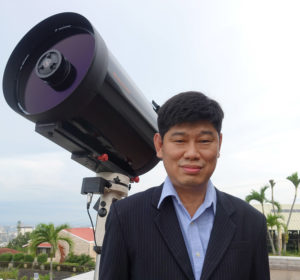
Christopher Go lives on the island of Cebu in the Philippines. He has been an amateur astronomer since 1986, the year of the return of Halley’s Comet. He studied at the University of San Carlos where he received a BS in physics.
Starting as an amateur astronomer with a pair of 10×40 binoculars, Chritopher Go would later own several different telescopes. He currently uses a Celestron C14 for planetary imaging.
Chris’s main astronomical interests are planetary imaging, particularly of Jupiter and Saturn.
In February 2006, Christopher Go discovered that the white spot Oval BA of Jupiter (later called Red Spot Jr.) had turned red. He joined planetary scientists Imke de Pater and Phil Marcus to observe Jupiter in the spring of 2006 with the Hubble Space Telescope. He was also involved with follow-up Hubble and Keck telescope observations of Jupiter.
In 2008, he received the Association of Lunar and Planetary Observers’ prestigious Walter Haas Award. In June 3, 2010, he confirmed the Jupiter Impact that was observed by Anthony Wesley. Asteroid 2000 EL157 has been named 30100Christophergo, in his honour.
Views: 5