

Related Events

Join Zoom
Free and open to the public held both inperson and online.
We have a new inperson location, “OCC Lecture Halls 1&2” of the “Orange Coast College,” next to the planetarium. Click here for parking instructions and more information.
The main speaker at this meeting will be joining us online from Pennsylvania.
Discovery of the Least Massive Known
Brown Dwarfs with
the James Webb Space Telescope
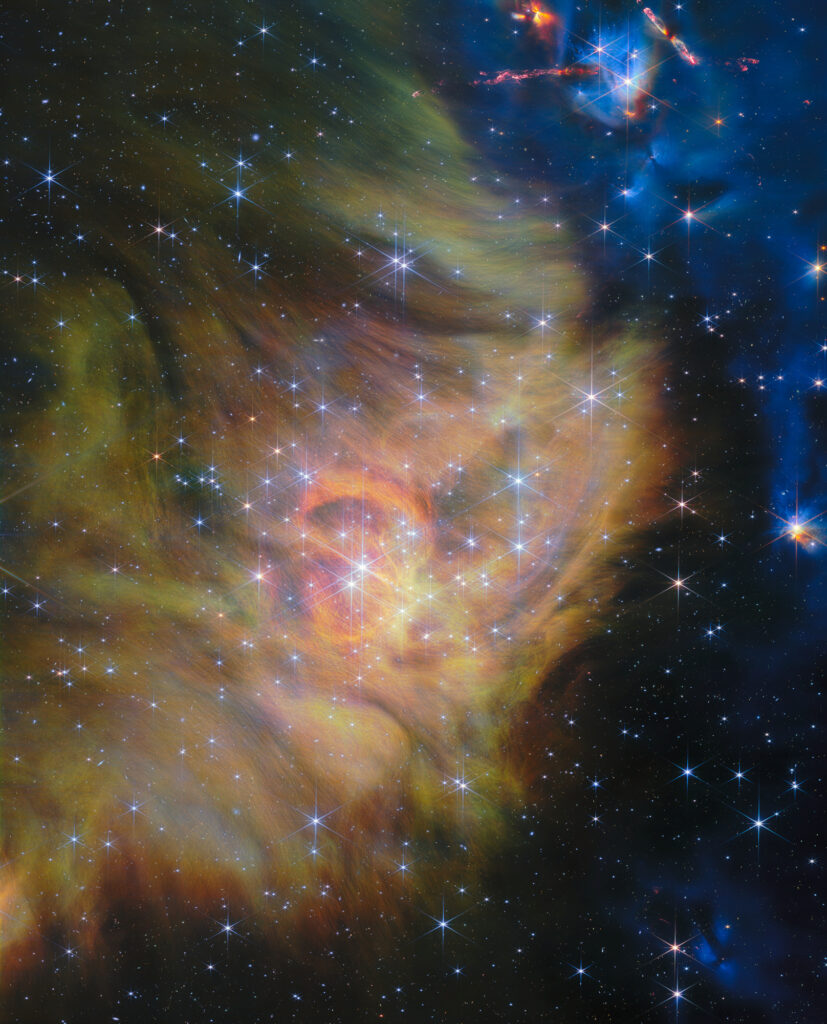
Stars exist across a wide range of masses, some more massive than the Sun and some less massive. If a star is less massive than roughly 8% of the Sun’s mass, or 80 times the mass of Jupiter, its center is too cool to sustain hydrogen fusion. These stars that lack fusion are known as brown dwarfs. One of the most fundamental questions about brown dwarfs is, what is the lowest mass at which they exist? We have used the most powerful infrared telescope to date, NASA’s James Webb Space Telescope, to search for brown dwarfs at very low masses in a nearby nebula that contains newborn stars. Through these observations, we have discovered brown dwarfs with masses as low as 0.2% of the Sun’s mass (twice the mass of Jupiter), making them the least massive known brown dwarfs. One surprising aspect of these new brown dwarfs is that their atmospheres contain an unidentified hydrocarbon that has not been previously detected in brown dwarfs or planets outside the solar system. It has been previously seen only in the atmospheres of Saturn and Titan. The presence of this hydrocarbon has not been predicted by any theoretical models of brown dwarfs, and its origin remains unknown.
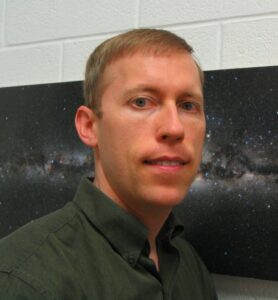
Kevin Luhman obtained undergraduate degrees in astronomy and physics at the University of Texas at Austin and a PhD in astronomy at the University of Arizona. He worked as a postdoctoral researcher at the Harvard-Smithsonian Center for Astrophysics and is now a professor at Penn State University. He uses ground- and space-based telescopes operating at optical and infrared wavelengths to study the birth of stars, brown dwarfs, and planets. He discovered the third and closest known systems
to the Sun, which consist of a binary brown dwarf and the coldest known brown dwarf.
Views: 1