
Online General Meeting – January 2021

Posted on by Reza

This is an online event, to attend please register with zoom using the link on the box above.

Dark Matter and the Dance of Dwarf Galaxies
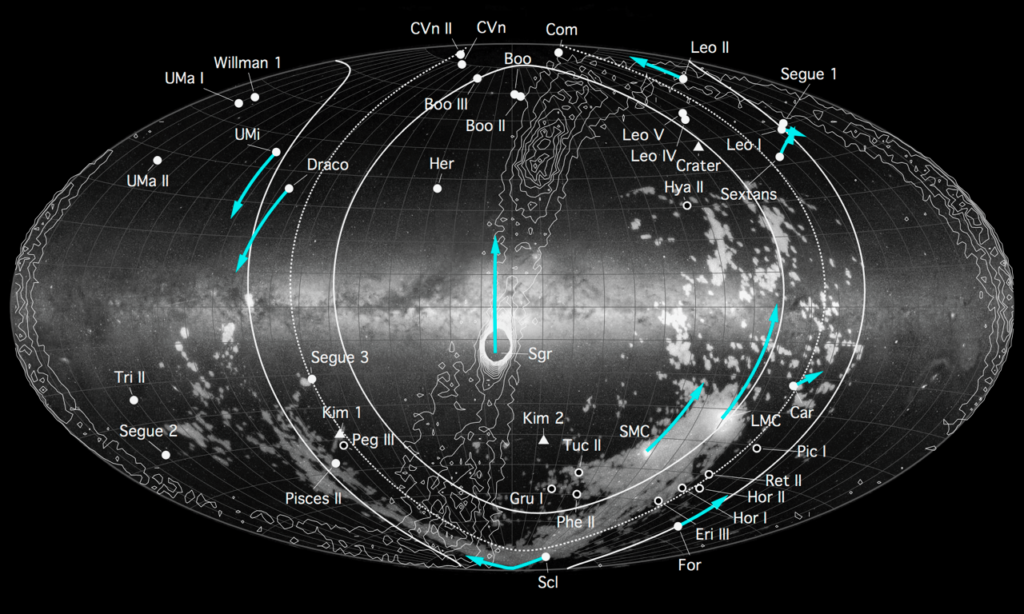
Major galaxies, such as our cosmic home the Milky Way, the nearby Andromeda galaxy, or Centaurus A, are surrounded by swarms of smaller dwarf satellite galaxies. Over the past 15 years, our knowledge of these satellite galaxies has exploded. The number of known Milky Way satellites has quadrupled, and highly precise measurements of their motions have provided unprecedented insights into their complex orbital dance. In my research, I investigate the distribution and motion of satellite galaxies to test our ideas of how the cosmos in general, and galaxies in particular, have formed and evolved. Our current leading model of cosmology was largely developed on cosmic scales, and implies that most of the mass in the Universe is dominated by unknown stuff: Dark Matter. Based on this cosmological model, computer simulations can nowadays follow the emergence and evolution of structure in model universes. These simulations predict the distribution and properties of galaxies down to the smallest scales (astronomically speaking). They predict a highly chaotic tangle of satellite galaxies. In contrast, my research finds that the observed situation resembles an ordered choreography: the satellite galaxies around the Milky Way, Andromeda, and Centaurus A are aligned along planes. Many satellites also move along these structures in a common direction. This finding poses a serious challenge to our model of cosmology – and might point at a fundamental misinterpretation of cosmic proportions.

Marcel S. Pawlowski

My research is situated at the intersection of observations and cosmological simulations. I am most interested in testing our cosmological knowledge and our understanding of the properties and dynamics of dwarf galaxies with observations of nearby systems of satellite galaxies. After receiving my PhD from the University of Bonn in 2013, I moved to the United States for a postdoc position at Case Western Reserve University in Cleveland, Ohio. In 2016, I was awarded a NASA Hubble Fellowship to work at the University of California Irvine. At the end of 2018 I moved back to Germany to my current position as Schwarzschild Fellow at the Leibniz-Institute for Astrophysics in Potsdam.

Views: 2

Full Moon

Posted on by David Searle

Views: 2

First Quarter Moon

Posted on by David Searle

Views: 3

New Moon

Posted on by David Searle

Views: 2

Last Quarter Moon

Posted on by David Searle

Views: 2

Powerful Telescopes for Teachers Around the World

Posted on by Reza

Teachers around the world need powerful resources to motivate, inspire, and educate their students. 

Now, we can unlock the wonders of the universe by providing educators with a revolutionary scientific instrument that connects their students to the cosmos, real astronomers and people around the world: the Unistellar eVscope.

51962450_1605742186519261_r.jpegThe Unistellar eVscope is a totally automated and easy-to-use telescopes that lets students capture images and collect real astronomical data even in light-polluted urban skies. See their website or overview video to learn more about the instrument. 

This GoFundMe campaign is for an “astronomy citizen science for education” pilot program. It aims to provide eVscopes to teachers around the world, who will work with our team as we develop an engaging, inquiry-based science curriculum that uses eVscopes in the classroom. Soon, their students can learn science by doing science!

https://www.gofundme.com/f/powerful-telescopes-for-teachers-around-the-world

Through this process, they’ll discover and confirm exoplanets, track and characterize asteroids for planetary defense, look for exploding supernova stars, comets, and in some cases even publish their work alongside professional scientists. 

Our pilot teachers for this program include:
-Ms. Susan Murabana from Kenya and the Traveling Telescope Program (link)
-Ms. Elizabeth Villanueva in Chile 
-Ms. Constanza Cintolesi in Chile
-Mr. Niraj Karna in Nepal
-Mr. Alvaro Folhas in Portugal
-Mr. David Platz in Australia
-Ms. Ceci Caballero in USA
-Mr. Kryston Tillett in USA
-and hopefully many many more

https://www.gofundme.com/f/powerful-telescopes-for-teachers-around-the-world
 
Our team working with these teachers includes: Global Hands-On Universe (GHOU) founder, Carl Pennypacker; Modeling Instruction education expert, Colleen Megowan-Romanowicz of the American Modeling Teachers Association (AMTA); University of Southern Queensland (USQ) PhD student and SETI Institute Unistellar Education Associate, Dan Peluso; Planetary Astronomer at SETI Institute and Chief Science Officer of Unistellar, Franck Marchis; and many others at GHOU, AMTA, USQ, Unistellar, and the SETI Institute.

Students around the world love exoplanets, especially the possibility of discovering a planet with intelligent life that could offer hope and guidance here on Earth.

The Global Hands-On Universe Program has already reached over 50,000 teachers around the world, and wants to expand their reach 100-fold. These Unistellar eVscopes are the only known instrument to enable real images and astronomical research quality data to reach our growing audience of eager teachers and students, in an easy-to-use, compact instrument that gives them complete control on the observation process.

Your generous donation will help bring the wonders of the cosmos to students around the world!

https://www.gofundme.com/f/powerful-telescopes-for-teachers-around-the-world

If you are an educator wishing to be involved in this pilot program and project, or are curious to learn more, or just have questions or want to give us some feedback or comments, please fill out this short FORM and we will get back to you. Thank you!

Views: 11

If It Isn’t Impossible, It Isn’t Worth Trying

Posted on by Reza

A talk at TEDxColoradoSprings by Dr. Marc Rayman form JPL.

Views: 3

Quadrantids Meteor Shower

Posted on by David Searle

The Quadrantids is an above average shower, with up to 40 meteors per hour at its peak. It is thought to be produced by dust grains left behind by an extinct comet known as 2003 EH1, which was discovered in 2003

Views: 1

Full Moon

Posted on by David Searle

The first full moon of the year is colloquially known as Wolf Moon in many northern cultures. A Full Moon occurs when the Sun and the Moon are on opposite sides of the Earth.

Views: 3

First Quarter Moon

Posted on by David Searle

Views: 2